…from slave to a first lady’s personal modiste and confidante.
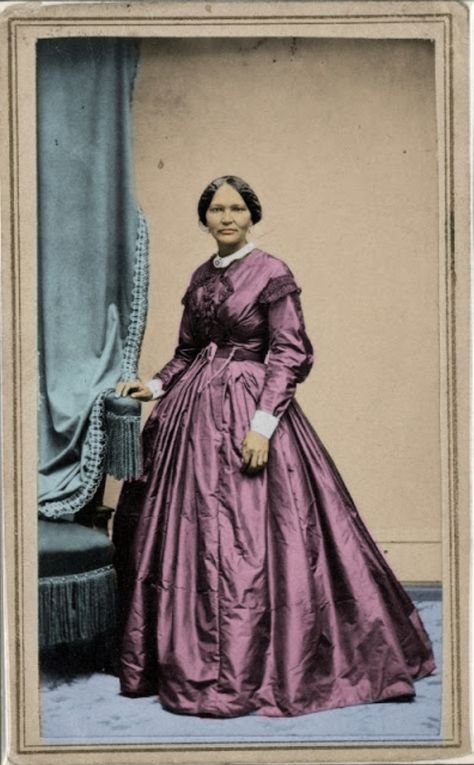
Elizabeth Keckely, Collection of Moorland-SpringarnResearch Centre, Howard University
Elizabeth Hobbs Keckley was the first Black dressmaker to achieve national prominence. Keckley was born a slave, in Dinwiddie Court-House, Virginia sometime in February 1818.
Separated from her family at eight years old, her early years were fraught with physical and sexual abuse. Sent as a wedding gift, to live in North Carolina with her owner’s eldest son, a minister and his wife; she suffered severe beatings and over a 4-year period was repeatedly raped by a church member eventually giving birth to her son George.
Elizabeth later returned to Virginia to live with the daughter of her previous owner; the family falling on hard times moved to St Louis where Elizabeth took on outside sewing jobs to supplement the family’s income. It was in St. Louis where Elizabeth began to make a name for herself using the family’s social connections to establish her reputation as a dressmaker making evening dresses for the society ladies of St. Louis. Keckley and her designs were so popular that she was able to earn enough money to support the family and the entire household.
Fashion for Freedom
Tirelessly working to support others for years, Elizabeth set her sights on gaining her freedom. There had been many opportunities to run away to the North, but wanting to be lawfully free she proposed to her owners, to purchase herself and her son. Her dressmaking skills and her ability to read and write made her a valuable asset to her owners and the price for her emancipation was set at $1,200.00. As hard, as she worked, she was unable to save enough, as she still had to support her owner’s family; eventually, she was able to obtain her freedom in 1855 with donations from benevolent customers. Elizabeth refuse to accept the aid as a gift and repaid all her patrons in 1860 before moving to Baltimore with her son.
Keckley endeavoured to earn a living in Baltimore by teaching young Black women her methods of cutting and fitting dresses; not having much success with this venture Elizabeth turned her sights to Washington, D.C. Once there she quickly developed a large clientele of the most wealthy and influential women in Washington.
Word of Keckley’s fine design skill and elegant dresses eventually reached the White House gaining her an introduction to First Lady Mary Todd Lincoln and subsequently designing all of the First Lady’s dresses, securing her the position as personal modiste during Abraham Lincoln’s presidency.
Skirt with evening bodice worn during the Washington Winter season 1861-62, Smithsonian Institution, First Ladies Collection
Mrs Lincoln was somewhat of a fashionista known for her sense of style, opulent fashions and jewellery. Cost was not a factor when it came to selecting jewellery and having her gowns designed to her requirements. One of her most extravagant gowns, made by Elizabeth, is a purple velvet ball gown worn during the winter 1861/62 social season. The bodice is piped with white satin and trimmed with mother-of-pearl buttons and like most gowns of the period, it featured both a daytime as well as an evening bodice. The gown is now part of the Smithsonian Institutes First Ladies Collection.
Elizabeth Keckley’s history would have been lost to us had she not written her memoir ” Behind the Scene or Thirty Years a Slave and Four Years in the White House”, published in 1868. The book was the first personal account of life in the White House and recounted the intimate moments of her role as White House insider immediately before and during the Civil War and revealed the close relationship she formed with Mary Todd Lincoln as friend and confidante. Written following President Lincoln’s assassination in an effort to aid Mrs Lincoln who had become so destitute she had resorted to selling her husband’s personal items as well as her wardrobe; the book was not well received. Criticised by the general public and press who deemed it scandalous, finding exception with the fact that a woman of colour could presume a friendship with a white woman especially the wife of President Lincoln. Lincoln’s eldest son, Robert was successful in having the book withdrawn from publication, thus Keckley failed to make a profit from its sale. She also suffered a decline in her business due to the negative publicity and her attempts to revive it were unsuccessful.
From 1892-1893 Keckley accepted the position as Head of the Domestic Arts department at Wilberforce University in Ohio. She lived much of her remaining years in obscurity. Elizabeth Hobbs Keckley, died on May 26, 1907, at the age of 88 and is buried at the Harmony Cemetry in Washington D.C.
Featured Image. This mosaic quilt, a popular style during the Civil War period, made between 1862 and 1880 is attributed to Elizabeth Keckley It is composed of scrap silks that have been embroidered and appliquéd, some possibly left-over scraps from Mary Todd Lincoln’s dresses.
Edelstein, Sari. “Elizabeth Hobbs Keckley (1818–1907).” Legacy: A Journal of American Women Writers, vol. 29 no. 1, 2012, p. 148-156. Project MUSE muse.jhu.edu/article/478347.
Benson, Samii Kennedy. Black fashion designers matter: A qualitative study exploring the experiences of Black female fashion design entrepreneurs.2017. Iowa State U, PhD Dissertation.

 The Errant Modiste